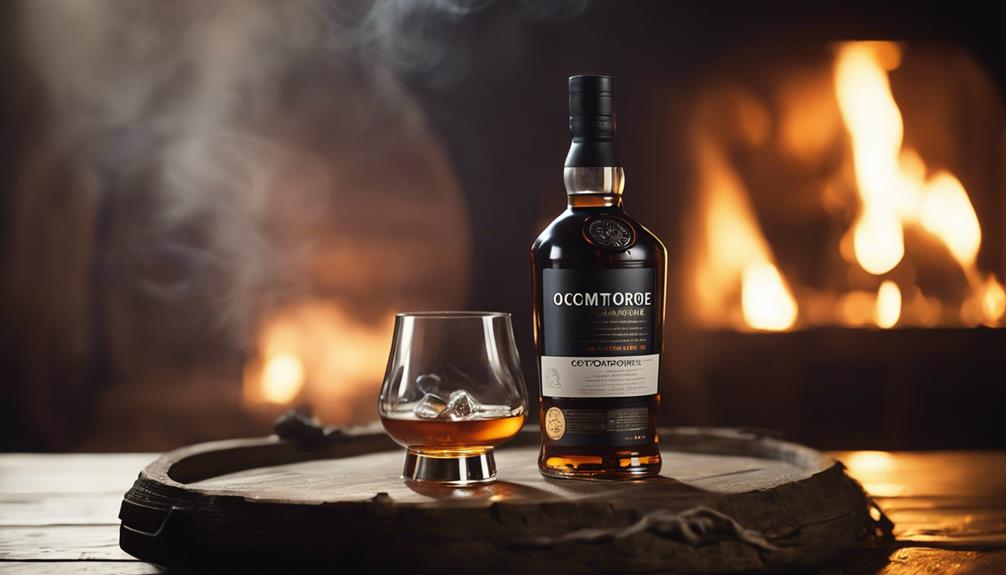
Octomore Whisky made waves in 2008 by pushing peating levels to new heights, reaching an impressive 131 ppm. The Bruichladdich Distillery, known for its dedication to craftsmanship, uses Scottish barley and a variety of cask types to create their innovative whiskies.
Octomore's range, with peating levels reaching up to 258 ppm, stands out for its bold flavors developed through maturation in diverse casks. This daring approach has sparked a surge of interest in heavily peated whiskies, inspiring experimentation across the industry.
Praised for their intense peatiness, Octomore whiskies blend robust smoke with sweet undertones, leading to long and satisfying finishes.
Octomore Whisky Origins

In the realm of Scotch whisky innovation, the inception of Octomore showcases Bruichladdich Distillery's bold and adventurous spirit. Launched in 2008, Octomore pushed the boundaries of traditional peating levels by introducing phenol contents that surpassed many established brands. This daring move marked a significant departure from the distillery's previous offerings, highlighting a commitment to exploring new flavor profiles and distillation techniques.
With an initial peating level of 131 ppm, Octomore set a new standard, attracting whisky enthusiasts in search of unmatched intensity and complexity. The use of various cask types, including ex-bourbon, European, and new oak, further enriched the range's depth of flavors. Consequently, Octomore quickly gained acclaim as a trailblazer in the evolution of Scotch whisky, captivating connoisseurs with its exceptional characteristics.
Production Techniques and Innovations
Focusing on traditional craftsmanship and innovative methods, Bruichladdich Distillery has implemented unique production techniques to craft its renowned whiskies. The distillery takes pride in its hands-on approach, avoiding automated or computer-controlled processes.
Barley, sourced mainly from Scotland with some grown on Islay, undergoes malting at Bairds Malt in Inverness. Water, a crucial element in whisky production, is sourced from three different locations to impart distinct flavor profiles.
Since 2003, the distillery has conducted onsite bottling without chill filtration, preserving the whisky's natural characteristics. Bruichladdich's commitment to quality is further demonstrated by retaining original Victorian-era equipment and the expertise of Master Distiller Jim McEwan, ensuring that each bottle of whisky reflects the distillery's dedication to excellence.
Peating Levels and Cask Aging

Peating levels and cask aging are crucial elements that shape the unique flavors of Bruichladdich Distillery's whiskies.
Octomore whiskies stand out for their exceptionally high peating levels, reaching up to 258 ppm in Octomore 6.2. This intense peating is achieved by using malted barley with phenol levels approaching 300 ppm, sourced from the Black Isle in mainland Scotland.
The whiskies undergo aging in a diverse range of casks, including ex-bourbon, European, and new oak casks. This maturation process plays a significant role in developing the final flavor profile, adding layers of complexity and depth to the spirit.
The combination of high peating levels and varied cask aging techniques results in Octomore whiskies being celebrated for their bold, intricate, and innovative flavor profiles.
Impact on Scotch Whisky Industry
The introduction of Octomore whiskies by Bruichladdich Distillery has had a significant impact on the Scotch whisky industry. Octomore, known for its exceptionally high peating levels, has revolutionized the industry by pushing the boundaries of traditional whisky-making.
This innovation has not only increased consumer interest in bold, heavily peated expressions but has also inspired other distilleries to experiment with higher levels of peat in their whiskies. The success of Octomore underscores the importance of innovation and diversity in the whisky world, encouraging distilleries to explore new horizons in flavor development.
The rise of Octomore signifies a growing trend towards bolder flavor profiles in Scotch whisky offerings, showcasing the industry's evolving landscape.
Tasting Notes and Reviews

Renowned for its bold and distinctive character, Octomore whiskies have earned widespread acclaim in the whisky community, with enthusiasts and experts alike praising their complex flavors and unique peating levels.
The Octomore range is celebrated for its intense peatiness, with peating levels reaching up to 258 ppm in certain expressions, surpassing many traditional peated whiskies.
Tasting notes often highlight the interplay of sweet and smoky flavors, with hints of salt, citrus, and oak adding layers of complexity to the palate.
Reviews frequently commend Octomore whiskies for their long, lingering finishes and the remarkable balance achieved between the robust peat smoke and the underlying malt sweetness.
Conclusion
In conclusion, Octomore whisky has truly revolutionized the industry with its bold peating levels and innovative production methods. Its impact on the Scotch whisky scene is unmistakable, setting new standards for complexity and artistry.
As we look back on Octomore's journey, it leads us to ponder: How far can whisky craftsmanship be pushed before it undergoes a complete redefinition?